
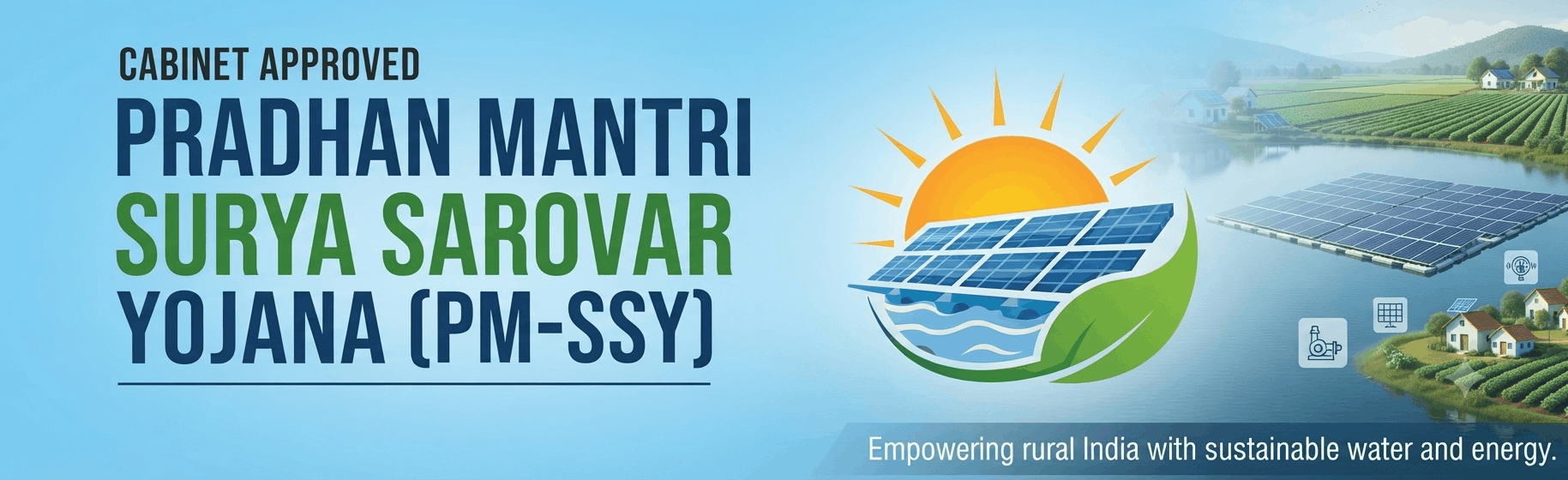
PM Surya Sarovar Yojana: Everything You Need to Know About India's New Eco-Development Initiative
Discover India's clean energy breakthrough with the PM Surya Sarovar Yojana. Backed by a ₹5,070 crore financial outlay, this revolutionary initiative aims to generate 5,000 MW of floating solar power across reservoirs and inland water bodies. Explore how this land-neutral green strategy preserves agricultural space, curtails water evaporation, and integrates energy storage to drive India toward a sustainable future.
India has firmly established itself as a global leader in the renewable energy transition. Building on ambitious goals to combat climate change, the Indian government introduced a landmark eco-development initiative: the PM Surya Sarovar Yojana (PM-SSY). Designed to fast-track clean energy generation without straining critical land resources, this scheme marks a revolutionary turn in how the nation harnesses power from the sun.
What is the PM Surya Sarovar Yojana?
The PM Surya Sarovar Yojana is a forward-thinking Central Sector Scheme engineered to scale up Floating Solar Photovoltaic (FSPV) projects across the country. Instead of occupying massive swaths of agricultural or residential land, solar panels are mounted on specially engineered buoyant platforms resting on existing water bodies like reservoirs, dams, lakes, and industrial water storage facilities.
Backed by a substantial financial outlay of ₹5,070 crore, the program is slated for implementation between the financial years 2026–27 and 2030–31. The core objective is to add 5,000 MW (5 GW) of clean floating solar capacity, transforming underutilized water surfaces into high-efficiency power generators.
Why Floating Solar? The Core Advantages
Traditional ground-mounted solar farms require large, continuous stretches of land, which can trigger land acquisition hurdles and compete with agriculture. The PM Surya Sarovar Yojana cleverly bypasses these roadblocks by taking the solar revolution to the water.
Land Preservation: By utilizing inland water bodies, the scheme protects valuable soil and agricultural acreage.
Enhanced Panel Efficiency: Solar panels typically lose efficiency as they heat up during peak sunlight hours. The natural cooling effect of the water underneath helps keep operating temperatures lower, thereby boosting energy generation.
Reduced Water Evaporation: Covering parts of a reservoir or lake with floating solar arrays blocks direct sunlight, substantially cutting down water loss through evaporation a massive win for drought-prone regions.
According to assessments by the National Institute of Solar Energy (NISE), India possesses an untapped floating solar potential of over 102 GWp, making initiatives like the PM Surya Sarovar Yojana essential to realizing this vast capacity.
Key Features and Strategic Mandates
The PM Surya Sarovar Yojana goes beyond simply placing solar panels on water; it introduces robust structural and financial components designed for long-term grid stability:
Mandatory Energy Storage Systems (ESS): A primary hurdle with renewable energy is its intermittent nature. To counter this, the scheme mandates that every approved project include a co-located Energy Storage System with a minimum storage duration of two hours. Across the entire program, this will create roughly 10,000 MWh of storage capacity, smoothing out power delivery.
Substantial Financial Support: To de-risk projects and attract private developers, the government offers Central Financial Assistance (CFA) of up to ₹1 crore per MW upon successful commissioning. Furthermore, an additional CFA of up to ₹50 lakh per project is earmarked for vital pre-development feasibility studies, including bathymetry, hydrography, and environmental assessments.
Execution and Oversight: The program is strategically executed under the oversight of key national agencies like the Solar Energy Corporation of India (SECI) to ensure seamless deployment and adherence to quality parameters.
Environmental and Economic Impact
The launch of the PM Surya Sarovar Yojana carries profound implications for India’s ecological footprint and socio-economic landscape:
Climate Goals: By expanding the country's floating solar footprint from its current minor base to over 5,700 MW, the initiative is projected to slash carbon dioxide emissions by approximately 10 million tonnes annually. This directly supports India's international commitments to achieve 500 GW of non-fossil fuel energy capacity.
Job Creation: The construction, maintenance, and technological integration phases of these massive water-based parks are estimated to generate between 16,000 and 17,000 full-time jobs, stimulating local economies and boosting domestic manufacturing of specialized floating platforms and anchoring tools.
Conclusion
The PM Surya Sarovar Yojana is more than just a renewable energy program; it is a masterclass in resource optimization. By transforming passive lakes and sprawling reservoirs into active powerhouses, India is successfully marrying water conservation with cutting-edge clean tech. As projects scale up over the next few years and industry stakeholders leverage specialized platforms like SambhavPro to streamline solar project execution and customer acquisition, this initiative will play a defining role in securing India’s energy future while safeguarding its precious land ecosystems.
SambhavPro Team
SambhavPro Team