PM Surya Ghar Rooftop Solar: MNRE Notifies New Branding Guidelines
The Ministry of New and Renewable Energy (MNRE) has introduced mandatory branding norms for rooftop solar installations under the PM Surya Ghar: Muft Bijli Yojana. Discover the official guidelines covering component placement, sizing, durability requirements, inspection protocols, and vendor penalties designed to ensure transparency and quality across India's residential solar sector.
The Ministry of New and Renewable Energy (MNRE) has taken a decisive step toward streamlining and standardizing India’s residential solar landscape. Through a recently issued Office Memorandum, the ministry has established a rigorous branding framework for all rooftop solar (RTS) installations executed under the flagship PM Surya Ghar: Muft Bijli Yojana.
With the ambitious target of solarizing one crore households by FY2026-27, this new policy ensures that every installation carries a stamp of official recognition, quality compliance, and uniform identification. For registered vendors, DISCOMs, and consumers alike, understanding these new guidelines is critical for smooth project execution and regulatory compliance.
The Core Objective: Visibility and Accountability
Launched to drive massive adoption of solar energy across residential households, the PM Surya Ghar scheme has witnessed widespread participation. However, scaling up to millions of homes requires robust quality control and clear oversight.
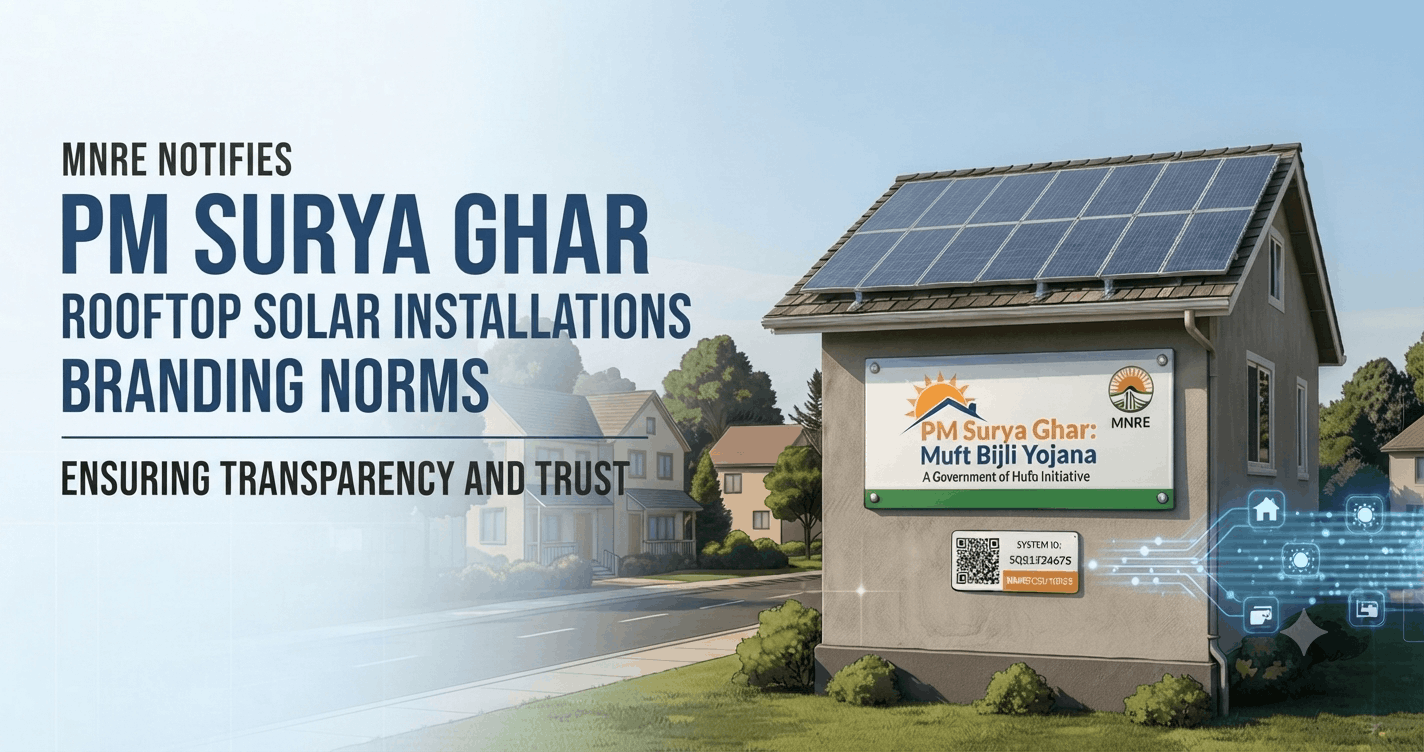
The introduction of standardized branding is aimed at creating uniform identification and visibility across installations nationwide. Whether a system is set up via regular CAPEX mode or the Utility-Led Aggregation (ULA) model, the official PMSG: MBY logo must now feature prominently on all key hardware components. This move not only bolsters program visibility but also acts as an accountability mechanism, making it easier for inspection agencies to trace installations back to authorized vendors.
Detailed Guidelines for Vendors and Equipment
The mandate applies comprehensively to all vendors undertaking installations under the scheme. It specifies exact dimensions, placement locations, and material standards for stickers across various system components:
Solar PV Modules:
Placement: Lower right corner of the front aluminum frame.
Sizing & Quantity: A recommended size of 25 mm × 25 mm, with at least one sticker provided per kilowatt of installed capacity (subject to a minimum of one sticker per module).
Important Caveat: The branding must strictly avoid obstructing OEM nameplates, serial numbers, QR codes, safety labels, warranty information, or technical specifications.
Solar Inverters and AC Distribution Boxes (ACDBs):
Placement: Lower right corner of the front exterior surface.
Sizing: A larger 50 mm × 50 mm sticker.
Operational Safety: Displays, ventilation openings, equipment labels, safety instructions, and regulatory markings must remain completely unobstructed.
Durability and Financial Responsibilities
Given that rooftop solar systems are exposed to harsh outdoor elements for decades, MNRE has set strict durability benchmarks for the branding materials. Stickers must be durable, weather-resistant, UV-resistant, waterproof, and corrosion-resistant.
Crucially, vendors bear the complete financial responsibility for this branding. No extra Central Financial Assistance (CFA) or subsidies will be provided by the government to cover branding costs. Furthermore, vendors are contractually responsible for replacing any damaged or faded stickers throughout the duration of the Comprehensive Maintenance Contract (CMC).
Inspection and Penalties for Non-Compliance
To ensure strict adherence, the oversight mechanism involves multiple layers of authority:
Enforcing Agencies: The National Programme Implementation Agency (NPIA), State Implementing Agencies (SIAs), and local DISCOMs are empowered to inspect installations both during and post-commissioning.
Rectification Power: These authorities retain the right to approve, modify, or order the rectification of branding arrangements if they do not meet official standards.
Strict Penalties: Non-compliance is taken very seriously. Vendors who fail to meet the branding norms after due notice face severe regulatory action, which may include de-registration as authorized vendors and other statutory penalties under applicable provisions.
Conclusion
For everyday consumers, this policy adds an extra layer of assurance. A properly branded system confirms that the installation has been executed by a legitimate, verified vendor under the official central scheme.
For the solar industry, these guidelines signal a maturation of the PM Surya Ghar ecosystem. While compliance introduces a minor operational overhead for vendors, it effectively eliminates substandard installations, weeds out fraudulent players, and builds deeper consumer trust. As India marches rapidly toward its FY2026-27 renewable energy milestones, transparent tracking and standardized branding will play an indispensable role in securing a sustainable, green future.
SambhavPro Team
SambhavPro Team